

Cheeky Logo
Ready To Get Hired?
Apply To Book A Free Call With Our Transition Specialist Team
Menu 12 years of Cheeky Scientist

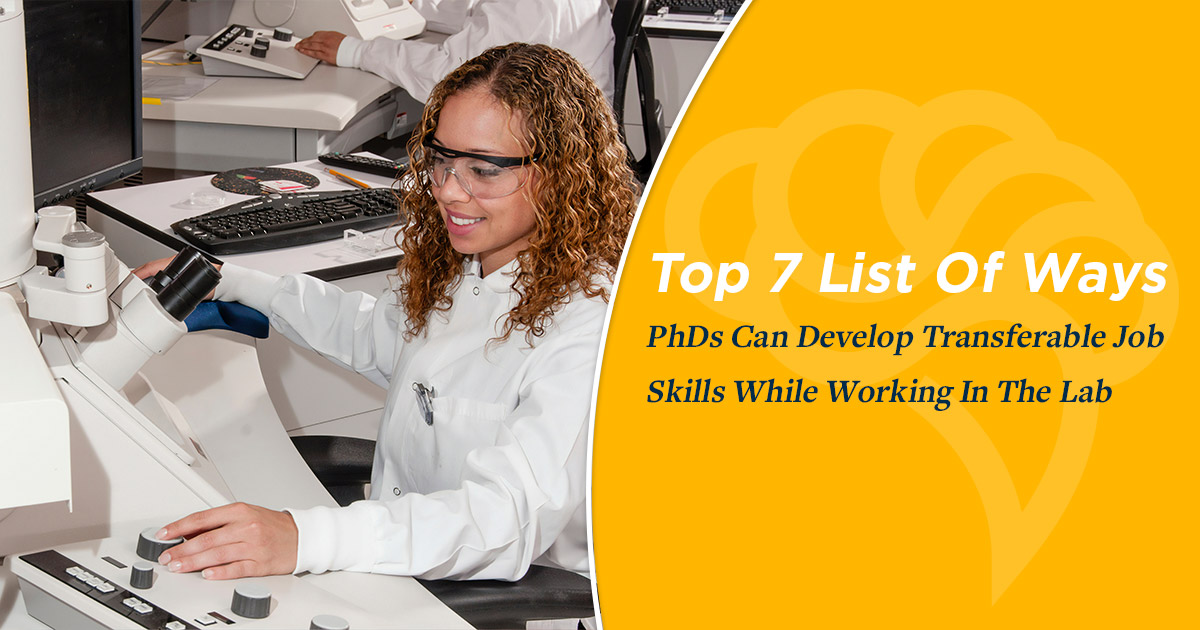
Top 7 List Of Ways PhDs Can Develop Transferable Job Skills While Working In The Lab
I spent over 7 years as a graduate researcher.

After all of this time, I finally realized that I didn’t want to stay in academia.

The academic system was broken and I wanted to move into industry instead.

However, I wasn’t sure I had the transferable skills I needed to get an industry job.

To be honest, I didn’t even know what transferable skills were.

Did I need to become a better communicator?

Did I need to learn how to sell?

I was confused about what transferable skills were and how to develop them so I decided to do nothing for a long time.

It wasn’t until much later that I realized transferable skills are a variety of things that can’t easily be defined.

Lifetime academics, journal editors, and such want us to believe that transferable skills are simply interpersonal skills or presentations skills, but this is an oversimplification of something much more complex.

Transferable skills are a collection of business lessons that you have learned in part in the lab and must develop further outside of the lab.

These skills range from how to deal with customers to how to understand a competitive business market.

They range from how to connect with high-level professionals to how to close business deals, how to get promoted, and how to understand product development, profit and loss, investment cycles, and much more.

As with most things, the best way to nurture transferable skills is through first hand experience.

The good news is you’ve already learned many of these skills in the lab, whether you realize it or not.

However, your education is incomplete.

If you want an industry job, you need to continue developing these skills.

Why PhDs Should Develop Their Transferable Skills

With the funding crunch in academia and the growth of the technology-based sector, an increasing number of science PhDs are interested in non-academic careers.

This has made getting an industry job even more competitive for PhDs.  

A report by the National Science Foundation shows that in life sciences field less than 10% of those who receive PhD training will go on to hold faculty positions in academia (National Science Foundation report, 2014).

In spite of the growing interest in getting industry jobs, many graduate students and postdocs struggle to secure jobs outside of academia.

The biggest reason so many PhDs fail to transition is that they lack knowledge and skills outside of scientific research.

If you’re a graduate student or postdoc who is considering a non-academic career, you must realize that your scientific knowledge and lab skills are not enough to get you an industry job.

Your hard skills alone will not get you hired.

You need to develop knowledge and expertise beyond scientific research to set yourself apart from the competition.

Close up of handshake in the office

How To Develop Transferable Job Skills 

Most PhDs fail to develop the transferable skills they need to get an industry job because they’re lazy and ill-informed.

These PhDs make excuses like being too busy in the lab or being under too much pressure from their academic advisor to do anything else.

As a result, they never develop the skills they need to transition into a non-academic career and instead, become stressed out and depressed.

The truth is there are many ways to learn and nurture transferable skills while still in the lab.

The key is that these skills are best learned first-hand, not by reading books.

You must find time to engage in activities that will help you identify and start to leverage the non-academic skills you need quickly.

Here are 7 ways to develop transferable career skills for industry while still working in the lab…

1. Take business-training courses.

Prospective employers often cite lack of formal industry training as one of the main reasons why they’re reluctant to hire science PhDs into non-R&D roles.

Graduate students and postdocs can overcome this obstacle by taking business courses at their institution or at neighboring institutions.

Many University business schools offer management courses geared towards training professionals how to manage scientific and technology-based industries.

If you’re at a University, check with the graduate school administration office to see which business schools and programs they are affiliated with.

Very often, you’ll be able to get into an evening business program at a reduced cost.

You may even be able to get your department to pay for your tuition by signing a petition waiver.

At the very least, you can audit business classes at your University.

Adding these experiences to your industry resume will go a long way with employers.

2. Consult with local startups, investors, and inventors.

Many startups are forced to maintain a lean workforce and as a result, do not have in-house scientific experts.

Instead, they utilize external scientific consultants.

Guess what—you are a scientific consultant. If you’re doing academic research at a PhD level, you are an expert in your field.

Start shopping around online to see which local startups are designing products and methodologies within your domain of expertise.

Once you make contact with a startup, you can offer to troubleshoot the technical issues they are facing.

By doing this, you will not only gain real-world experience, you will build a very strong industry network.

You can also connect with local inventors, investors, and even venture capitalist firms.

These people are always on the lookout for new technologies and expert knowledge that could be translated into new technologies.

If you’re in the UK, be sure to look into the Knowledge Transfer Partnership (KTP) program.

Some UK universities have teamed up with local businesses to develop a special work placement program for graduate and postdoctoral researchers.

Through the KTP program, PhDs are offered a paid position for 2-3 years in a local technology-based business.

This is a great way for UK PhDs to learn and nurture transferable skills for industry.

3. Protect your lab’s intellectual property.

Nearly every lab yields scientific results that could benefit from intellectual property protection.

By becoming involved in protecting the intellectual property generated in your lab, you can rapidly develop valuable transferable skills.  

You do not need intellectual property training or detailed knowledge about patent law to do this.

Most of the initial work related to patents and other intellectual property documents merely requires the detailed scientific knowledge you already have.

As a graduate student or postdoc, you can draft patents and deal with material transfer agreements and other intellectual property documents.

A big advantage in learning how to protect your lab’s intellectual property is establishing connections in the Office of Technology Transfer.

The Office of Technology Transfer deals with licensing and commercialization of inventions coming out of the University labs.

Working or volunteering at the tech transfer office is a great opportunity for PhDs to gain experience of the steps involved in the commercialization of scientific technologies.

You will learn about licensing, intellectual property law, and how to promote inventions to prospective investors.

Since the Office of Technology Transfer is responsible for facilitating the growth of University startups and spinoffs, you will also gain exposure to business development.

4. Register for summer internships.

Many science PhDs and postdocs incorrectly assume that internships are only for undergrads.

However, there are number of major companies who offer short summer workshops and internships and many Universities that allow graduate researchers to do such internships.

These internships are offered by large biotechnology and biopharmaceutical companies, consulting firms, and intellectual property firms.

If you do an internship in a non-research role that is aligned with the career you want to pursue, it will allow you to rapidly develop the transferable skills you need to get an industry job.

5. Get involved in community projects.

Local science organizations frequently make requests to universities for scientific speakers.

These organizations are hungry for graduate students and postdocs who are willing to talk about science to local middle schools, high schools, and community clubs.

Volunteering in your community is a great avenue for networking demonstrating alternative skill sets.

Another way you can get involved in your community is by writing for local organizations, both in your field of scientific expertise, and outside of it.

Writing on topics outside your field of scientific expertise will not only improve your written communication skills but will also show industry employers that you have broad interpersonal skills.

6. Attend alternative career workshops and conferences.

When it comes to transitioning into industry, the biggest mistake PhDs can make is networking only with other PhDs.

Instead, PhDs should be going to non-PhD networking events.

Nowadays, every state and county has multiple organizations whose purpose is to facilitate networking among professionals and students in the technology sector.

These local bodies often hold workshops or local events aimed toward bridging the gap between industry and academia.

Alternative career workshops are the perfect place to develop your transferable skills and learn about different industry jobs.

Importantly, don’t assume that the only places to network are at major conferences.

No matter where you live, there are many local meet-ups and workshops in your area.

Simply check meetup.com, eventbrite.com, and other event websites to start finding workshops near you.

Your goal should be to regularly make time for local networking events so that you repeatedly meet professionals in your area.

Unlike large annual conferences, these local meetings allow you to build a strong connections with other professionals.

These strong connections are crucial to getting networking referrals for industry jobs.

7. Organize networking events yourself.

If you cannot find a workshop near you, create one.

Taking the initiative to host a meet-up is a great way to develop transferable skills. It’s also something you can put on your industry resume.

Employers respect PhDs who initiate events, especially industry-related events.

There are graduate students and postdocs at every institution who are interested in alternative careers.

This makes arranging workshops and inviting guest speakers both easy and beneficial to others.

If you don’t know where to start, you can do what I did and contact the Cheeky Scientist Seminar Series to book a seminar at or near your institution.

Importantly, organizing a networking event yourself will show industry employers that you are an action-taker with leadership skills.

Self-organized events are an ideal platform for establishing connections with industry professionals and developing the skills necessary to be successful outside of academia.

All of the above activities will help you develop the transferable job skills you need to have a successful PhD career outside of academia. Too many graduate students and postdoc spend the majority of their lives working in the lab, including weekends and holidays. As a result, it’s easy to feel like there’s absolutely no time to develop transferable skills for industry. However, small actions, when done consistently, add up to big changes. By spending just 10 minutes a day on one or two of the items above, you can make a substantial difference in terms of your transferable skills over the course of a few months. These small efforts will add up quickly and will improve your chances of landing the industry job you really want.

If you’re ready to start your transition into industry, you can apply to book a free Transition Call with our founder Isaiah Hankel, PhD or one of our Transition Specialists. Apply to book a Transition Call here.

ABOUT ARUNODOY SUR, PHD

Arunodoy is a Ph.D. in Integrative Biology and has training in intellectual property, entrepreneurship, and venture capitalism. He also has experience with global biotechnology and biopharmaceutical companies, including clinical trial consulting. Arunodoy is passionate about the translation of academic research to the real world and commercialization of scientific innovation so that it can help solve problems and benefit people. He possesses in-depth understanding of both technological and commercial aspects associated with the life science industry.

Arunodoy Sur, PhD

Here's What Others Are Saying

"Thank you so much for all the help. I got so much help and inspiration by joining Cheeky!"

Hasala Lokupitiya

Hasala Lokupitiya

Senior Polymer Scientist

at Lyten

"I’m excited to share that i am starting my new job as a technical support engineer at lumencor, inc. the ultimate goal is to grow potatoes on mars by 2050 and make other advaces for mankind."

 Andrii Repula

Andrii Repula

Technical Support Engineer

at Lumencor, Inc.

"A new chapter begins! I'm thrilled to launch Wenwirth Scientific, where sincere meets creativity with a mission to make medical communication more engaging, impactful, and effective. I am ready to bring game-changing ideas to help you unleash the power of words and medicine. Many thanks to those who have supported me in this journey, I can't wait to work with you and start serving the healthcare community and patients."

Huey Wen Lee

Huey Wen Lee

Creative Medical Communications

at Wenworth Scientific

"I am happy to share I am starting a new position!"

Mary Hidde

Mary Hidde

Clinical trial manager

at Medspace

"The made an offer and I accepted it. I am excited and nervous to start a new job and leave academia!"

Valentina Dallacasagrande

Valentina Dallacasagrande

Sr. Scientific Advisor

at reVision Therapeutics, Inc.

"I got an offer at Estée Lauder! I accepted the offer since it is a great company and less than 15 min away. I don't have to worry about relocating."

Ivan Peran

Ivan Peran

at Estée Lauder

"Aside from all the technical pieces, the comradery, I really had an excellent time at the symposium that I was in Florida, that was super helpful...having a community that takes a part in your wins and also helps you pick yourself up and dusts yourself off when you don't get those wins and that you're not alone."

Christine Lo Bue-Estes

Christine Lo Bue-Estes

Medical Communications

at NBA

"New offer - went ahead and signed contract today - - excited and thank you for the confidence booster - grateful for investing in Cheeky Scientist."

Wael Bahnan

Wael Bahnan

Senior Scientist

at Minervx ApS

"I'm happy to share that I'm stating a new position as Medical Science Liaison at Celltrion Healthcare Co, Ltd.!"

Tammy Virdi

Tammy Virdi

MSL

at Celltrion Healthcare Co, Ltd

"After being unexpectedly laid off in October, the journey to this moment was not straightforward. It was a period filled with uncertainty, but also growth, resilience, and a renewed sense of purpose. I dedicated myself to learning and exploring new opportunities, which has led me to this incredible new role I just got hired into."

Chris Ewing, Ph.D.

Chris Ewing, Ph.D.

"I picked the Planet job! It ended up being the better fit for me... Thanks for all of your help!"

Emily Martin

Emily Martin

Hardware Systems Engineer

at Planet

"Thank you for your advice, Isaiah! I’m super excited and grateful! I would never negotiate the salary and the other details of the offer if it weren’t for Cheeky Scientist. Thank you again"

Marta Silva

Marta Silva

Policy Analyst

at Health Canada

"I'm happy to share that I will be starting a new position as MSL at Sanofi! I want to thank everyone that took the time to speak with me about their MSL experience and to help me land this position!"

John Crawford

John Crawford

MSL-Vaccines

at Sanofi

"I signed the offer today! I am will be working as a technical support manager - it is what you call a field scientist within Cheeky. I am super excited and already feel welcomed!"

Maria Terra Terra

Maria Terra Terra

Technical Support Manager

"I would like to express my appreciation and assure that your school was eye-openning, thanks! I registered on your course 2 months ago and from total ghosting I ended up with a dream job in biotech."

Petro Starokadomskyy

Petro Starokadomskyy

Senior Scientist

at Kyverna Therapeutics

Similar Articles

Have A PhD And Over 40 Years Old? Better Do This

Have A PhD And Over 40 Years Old? Better Do This

By: Cheeky Scientist

“Isaiah, I’ve got 15 years of experience, a PhD, and more publications than I can count, yet no one seems to want to hire me.  What am I doing wrong?”  I hear this from PhDs over the age of 40 who are struggling to get their foot in the door, and the truth is, your age and experience may be working against you in today’s job market.  Employers, especially younger hiring managers, may see you as overqualified, set in your ways, or not as easily trainable as a younger candidate.  The unfortunate reality is that ageism is rampant in today’s…

Why PhDs Are Mentally Tough (& How They Use It To Get Hired)

Why PhDs Are Mentally Tough (& How They Use It To Get Hired)

By: Cheeky Scientist

“Isaiah, I’m at my wit’s end.  I’ve applied to countless jobs, networked extensively, and still, nothing.  It feels like I’m just spinning my wheels.”  This is a sentiment I hear often from PhDs who are navigating the challenging waters of the job market.  The frustration and mental fatigue are real, especially when you’re used to achieving high levels of success in academia.  But let’s get one thing straight – you are not alone, and this is not the end.  It’s just a bump in the road.  Yes, the job search is grueling.  There’s no sugar-coating it.  But here’s the thing…

5 Miscalculations That Are Holding You Hostage In Academia

5 Miscalculations That Are Holding You Hostage In Academia

By: Cheeky Scientist

As a PhD student, I felt more and more lost the closer I came to graduation. That’s because I had started to doubt that I knew what I wanted anymore. You could say I was torn, but that would be an understatement. I was absolutely wracked with indecision. My original plan had been to continue on in academia.  I was going to apply for a postdoc.  Then on to Assistant Professor.  And so on. However, I was starting to see a real pattern emerge among the PhD graduates I knew. I liked to check in periodically with those colleagues and…

Is Cheeky Scientist A Scam? Who Shouldn't Join The Association

Is Cheeky Scientist A Scam? Who Shouldn't Join The Association

By: Cheeky Scientist

Is Cheeky Scientist a scam?   Has anyone here had any experience with the Cheeky Scientist Association? Is Cheeky Scientist worth it?  What’s the deal with Cheeky Scientist? Is Cheeky Scientist legit? PhDs are trained to be critical.  In academia and in life, every decision they’re faced with is made with extreme prejudice. Examining facts, collecting resources, and determining what is a trustworthy source of information is one of their biggest strengths.  PhDs have superior critical thinking skills, so it makes sense for them to carefully consider any investment – even if it’s an investment in themselves. And in almost every…

Should You Delete Your PhD From Your Resume? The Answer May Surprise You

Should You Delete Your PhD From Your Resume? The Answer May Surprise You

By: Cheeky Scientist

If you have a PhD, you’re overqualified for an industry job. PhDs are lab rats and can’t understand business. You can’t get a job without industry experience. Do any of these sentences sound familiar to you? Have you been looking for an industry job unsuccessfully and have reached a point where you ask yourself if your PhD has any value whatsoever? These sentences are myths, commonly said by either academics who don’t understand anything about industry, or by other job candidates who don’t want to compete with PhDs. Hiring managers for PhD-level industry positions want the best candidates possible. After…

4 Skills PhDs Have That Employers Are Desperately Seeking

4 Skills PhDs Have That Employers Are Desperately Seeking

By: Cheeky Scientist

The number of PhDs wanting to transition out of academia increases every year. Initially, most of these PhDs were recent graduates and postdocs.  But as the crisis in academia has gotten worse, we are seeing a lot of adjunct and even tenured professors wanting to leave. They feel professionally unfulfilled in academic positions because they are overworked, work in uninspiring roles, and/or are paid marginal academic stipends, fellowships, and wages.  Far too many PhDs are unable to find any meaning or joy in their academic careers, which negatively impacts both their professional and personal lives. Unfortunately, many of these PhDs end up…

The Exciting (or, Dreadful) First 90 Days Of A New Job. Here's What To Expect

The Exciting (or, Dreadful) First 90 Days Of A New Job. Here's What To Expect

By: Cheeky Scientist

Like many PhDs, I thought I could jump into my first industry position ready to hit the ground running. Much to my surprise, this was not the case.   During the first few months of my new position, I felt like I was drowning. Everything I thought I knew about my field, how research is conducted, and how companies operate was turned on its head. I was not prepared for this major shift, and it showed. I waivered between trying to impress my managers and sitting mute in meetings, intimidated by everyone in the room. If I had known what…

The Inside Scoop On The Industry Onboarding Process

The Inside Scoop On The Industry Onboarding Process

By: Cheeky Scientist

Nothing could prepare me for the shock I received walking into my first industry onboarding experience. Literally, everything was different from what I had experienced in academia. The processes, the culture, the pace – absolutely everything. I also had no idea what onboarding meant. I heard the word tossed around but, to me, it was just the process you went through to get all the mandatory paperwork out of the way. That was so far from the truth. My first onboarding experience lasted almost 6 months. Yet, throughout that whole process, I had no idea that I was still being…

The One Productivity Hack Every PhD Needs To Get Hired In Industry

The One Productivity Hack Every PhD Needs To Get Hired In Industry

By: Cheeky Scientist

If your job search isn’t producing results, perhaps you’re doing too little. Or, just as likely, you’re doing too much… too much of the wrong things. You may think “If I just spent more hours of the day searching and applying for jobs, I’m sure to land a job eventually.” But investing more time into a job search without a strategy is time wasted. An effective job search strategy is one that conserves our most precious resource: our mental energy.   Protecting your mental energy is the one productivity hack that every PhD needs to get hired in industry. As…

Our Members Get Hired At Top Industry Companies

Visa Company LogoLumencor Company LogoPeloton Company LogoIqvia Company LogoIcon PLC Company LogoSanofi Company LogoHouston Methodist Company LogoParexel Company LogoSite Bridge Research Company LogoHuman Genomics Company LogoIsscr Company LogoTesla Motors Company LogoNetflix Company LogoAbbvie Company LogoOxford Nanopore Technologies Company LogoPfizer Company LogoOdin Vision Company LogoGoogle Company LogoMeta Company LogoCDC Company LogoDoor Dash Company LogoBASF Company LogoMicrosoft Company LogoKPMG Company LogoImmatics Company LogoDisney Company LogoDeloitte Company LogoJohnson and Johnson Company LogoMedtronic Company LogoIntel Company LogoTempus Company LogoEngenius Micro Company LogoAnswer lab Company LogoAmazon Company LogoHome Depot Company LogoGene Fab Company LogoToyota Company LogoThermo Fisher Scientific Company LogoStraight as Gymnastics Company Logoregeneron Company LogoCoca-Cola Company LogoCostco Company Logo

Top Industry Career eBooks

Industry Resume Guide for PhDs

Industry Resume Guide for PhDs

Cheeky Scientist

Learn how to craft the perfect industry resume to attract employers. In this eBook for PhDs, you will get access to proven resume templates, learn how to structure your bullet points, and discover which keywords industry employers want to see most on PhD resumes.

20 Skills To Put On Your Resume & LinkedIn Profile

20 Skills To Put On Your Resume & LinkedIn Profile

Cheeky Scientist

Learn the top 20 transferable skills that industry employers ranked as “most important” for PhDs to include on their resumes and LinkedIn profiles. In this eBook, you will learn to start speaking the language of industry so that hiring software algorithms and hiring managers will notice you.

Complete LinkedIn Guide For PhDs

Complete LinkedIn Guide For PhDs

Cheeky Scientist

Learn how to increase your LinkedIn visibility to employers by improving your SSI score and overall LinkedIn connections. In this ebook, you'll be given the tools you need to attract recruiters to you from LinkedIn Recruiter and drive employee referrals.