
Cheeky Logo
Ready To Get Hired?
Apply To Book A Free Call With Our Transition Specialist Team
Menu 12 years of Cheeky Scientist

3 Factors PhDs Must Consider When Deciding Company Fit

If you recently started your job search, you probably feel the pressure of proving that you’re a good fit for the industry roles you’re applying to. 

You have to carefully craft your cover letter, resume, and LinkedIn profile, and prepare for countless interviews just to prove you’re  qualified for a position. 

This pressure can make you feel that employers hold all the power, and the only thing that matters is convincing them that you’re the best candidate for the role.

Don’t let this pressure make you neglect other key components of a successful career, like company fit. 

You’ll likely accept a position because you’re drawn to the work, but you’ll stay because you like the work environment.

Here’s what one of our members had to say about company fit after a their first transition:

In my first industry job search, I was so focused on what kind of career I wanted that I failed to thoroughly assess what kind of work environment was most aligned with my ideal professional lifestyle. 

Before I even finished my PhD, I received a job offer. I was so thrilled that I accepted immediately with resounding enthusiasm. 

After 8 months, I left the position. Not only was the company not a good fit, but the job itself did not align with my talents or my work style, leaving me unfulfilled and unproductive.  

My advice to other PhDs entering industry: have a clear idea of the kind of work environment you want and take your time with the job search. 

Don’t undersell your talents and jump at the first opportunity that comes along. You might regret it in the long-term.

Company Fit(ness) Matters More Than You Think

Most employees rate the work environment – type of company and organizational culture – as one of the top reasons they stay or leave a given position. 

And for good reason. Being in an environment that nurtures your talents and allows you to perform at your best is crucial to succeeding in any career.

While this may seem self-evident, the recent pandemic has shed further light on how problematic a poor work environment actually is, and has empowered many, particularly those in academia, to reassess their working conditions.  

We spend most of our waking hours at work. So, why do we overlook the importance of enjoying our work environment? 

Would you live in a home that caused you undue stress, made you anxious, or diminished your joy? I doubt it. Which is why most people take home-buying very seriously, carefully weighing their options. 

Deciding which company you call “home” is also a big decision and you should treat it as such. If you make the right choice, your next career move won’t be a mere stepping-stone, but the start of a long and prosperous career.

3 Company Characteristics You Should Consider To Find The Right Fit

Identifying your best company fit begins with self-assessment.  

Think of a time when you were highly productive – what was unique about that situation? Were you in a work environment that nurtured innovation or had explicit methodologies in place? Was your work independent or team-oriented? Were you working as part of a large, highly structured organization or a small group that lacked a formal chain of command? 

The answer to these questions will allow you to assess how and where you do your best work. A company that offers a worked environment that aligns with your answers is likely your best fit.

Below, I will take a look at three major attributes you should consider when assessing company fit. 

1. Size

You may not think that the size of the company you work for is a big deal – but think again. 

In academia, lab size is intrinsically limited and even the largest academic labs barely equate to the size of a small company. In industry, company size ranges from a hundred to tens of thousands of employees.

The size of a company impacts the flow of production and communication and, in turn, how people work. 

Larger companies are more likely to have well-defined divisions of labor and reporting structures. Employees’ responsibilities closely adhere to a specific job description, and careers follow a predefined path. 

If you enjoy a highly structured environment, want a defined role where you can hone a desired skill set, or you breathe easier having an established route for upward mobility, a large company might be a good fit. 

However, if you thrived in a small startup lab where you were required to wear many hats and enjoyed a close-knit group of colleagues during your time in academia, a small company may be the place for you.

2. Hierarchy

If you’ve never had an industry job, the concept of hierarchy or power structure, might be new to you. 

After all, hierarchy is almost nonexistent in academia – there’s a PI and then there’s everyone else below them. 

However, in industry, there are different hierarchical structures. Some may be organized by division or department based on function, geographical location, and/or project type while others are more fluid or flat.

In general, hierarchy is highly intertwined with the size of the company with equally sized companies often adopting similar company structures.

Large companies often follow a strict hierarchy that includes multiple layers of management (senior, junior, middle). 

In this type of hierarchy, lines of communication flow from top to bottom (or vice versa) and each employee has an assigned reporting manager. In a strict hierarchy, each employee has a clearly defined role. 

If you prefer structure, distinct levels of seniority, and a clearly defined role, a company with a strict hierarchy may be your winning option. 

Small companies are likely to adopt a more fluid or flat structure where the lines between roles and management levels are less distinct. 

In this type of structure, communication is more fluid, employees may take on a broader range of responsibilities and may experience more frequent operational changes. 

If you yawn at the notion of rigid processes, love the idea of taking on new and unknown challenges, and want to have many options for career progression, look for companies with more fluid or flat hierarchies.

Keep in mind that not all large companies will have a strict hierarchy and not all small companies will have a fluid structure. This is something you should research beforehand.

3. Culture

The term company culture refers to the personality of an organization: its values, attitudes, goals, and overall ideology. 

In essence, it defines the company’s objectives and establishes how these objectives will be met. 

It’s possible that when you think of company culture images of office parties, ping-pong tables, and the occasional casual Friday come to mind. 

But these are only the surface, true company culture lies in the intangibles. 

Three distinct features will provide you with insight into a company’s culture: behavior, symbols, and systems.

Behavior is how the organization and its employees act, speak, and carry themselves. 

During a job interview, observe how the employees communicate. Their tone. Their words of choice. Their engagement in the conversation. 

An engaged  employee who chooses words that align closely with the company’s core values is more likely to be satisfied with their job than one who seems disengaged and uses words with a negative connotation.

Symbols are subtle features of a work environment – company logos, wall hangings, personal workspaces, seating arrangements – that communicate what a company values and prioritizes. 

Is the workspace sterile and devoid of decor? Are employees working in an open space or behind closed doors? Is the hierarchy within the company evident based on seating arrangements or space allocation? 

Taking note of these seemingly irrelevant features will help you to determine whether you would be comfortable working in that environment. 

Systems are the processes a business puts in place to achieve its objectives. These can include anything from organizational structure and infrastructure to employee recognition and performance management. 

To gain insight into how a company operates, you can inquire about the process the company uses to take a project from inception to market. This will give you an opening to discuss the company structure in more detail. 

You may think gaining insight into company culture before getting hired is difficult, but the information is out there if you take the time to look for it.

Most businesses have a company website and a presence in social media like Twitter or LinkedIn. You can also go deeper by looking at review sites like GlassDoor. 

The company’s website can give you a broad overview of its immediate goals and where the company is headed in the future. 

Social media and online reviews can also provide you with information on their priorities, how they posture in the public eye, and how both current and previous employees rate their experience. 

These resources are helpful, but keep in mind that many companies are guilty of virtue signaling (making statements not backed by action for the sole purpose of improving their public standing) and that those most apt to leave a review are current or former employees who are dissatisfied with their experience.

You can also learn a lot about the inner workings of a company by performing informational interviews with current and former employees. 

Finally, take full advantage of your interview process. While the primary aim of an interview is to assess your fitness for a particular position, this is also your chance to better understand the company’s organizational behavior and decide if it’s a good fit for you.

Ask questions that promote engagement with the interviewer. For example, instead of asking “How is the company culture?”, you could ask “If a newspaper wanted to write an article about the company’s culture, what would it have to include?” 

Asking more pointed and creative questions will increase the likelihood of a candid response while simultaneously demonstrating your knowledge of industry etiquette.You can also get some intel on business behavior by showing up early to a site visit. This will allow you to observe people’s behavior and determine if the environment matches your desired professional lifestyle.

Concluding Remarks

Success and long-term fulfillment require more than doing a job you enjoy or receiving a good paycheck. It’s also not as simple as working for a Fortune 500 company or a rapidly growing startup. Your ability to advance in a field depends largely on how well your goals, values, and workstyle align with the company that employs you. To identify your company fit, you should consider the characteristics of a company that impact how you perform your work, such as its size, its hierarchy, and its culture, and compare them to your desired professional lifestyle. This will allow you to craft a more conscientious job search strategy and, ultimately, to land not only your ideal job, but your ideal workplace.

If you’re ready to start your transition into industry, you can apply to book a free Transition Call with our founder Isaiah Hankel, PhD or one of our Transition Specialists. Apply to book a Transition Call here.

ABOUT CHEEKY SCIENTIST

Here's What Others Are Saying

"I finally signed my contract and will be starting soon! I am very happy with the compensation package they have offered me and it meets my expectations."

Indrani Mukrajee

Indrani Mukrajee

Product Manager

at Miltenyi

"I am delighted to announce that I have accepted the role of Research Scientist with a base salary of 90k. The cheeky scientist resources have helped me immensely and I am really grateful."

Amninder Singh Sekhon

Amninder Singh Sekhon

Research Scientist

"Thank you for the assistance from the CSA these last couple of months. I was offered the position with a life science investment firm this week and I happily accepted the offer. Growth with the company is guaranteed and I hope that this will be the last time I have to interview in NYC (lol)."

Ilke Roelofse

Ilke Roelofse

"I'm excited to announce that I have accepted a position as an Innovations Analyst at Cleveland Clinic. Looking forward to using my background to help commercialize healthcare innovations!"

Joe Thomas

Joe Thomas

Innovations Analyst

at Cleveland Clinic

"I'm happy to share that I'm starting a new position as Founder at Relearning Earning!""

James Wadsworth

James Wadsworth

Founder

at Relearning Earning

"Good news...I've secured a job! Thank you for your support during the job search process and for giving me the courage to transition from academia to industry."

Marlyn Brookins

Marlyn Brookins

Regulatory Submissions Coordinator

"BIG NEWS!! Lufthansa offered me the gig!!"

Marco Milesi

Marco Milesi

at Lufthansa

"I landed a dream job as a revenue management analyst at british airways."

James Washak

James Washak

Revenue Management Analyst

at British Airways

"I am happy to share that I'm starting a new position as a European Portfolio Manager at Scientific Instruments!"

 Shikha Acharya

Shikha Acharya

European Portfolio Manager

at Scientific Instruments

"Just wanted to say thank you for all your help and motivation.You were great in guiding me in the right direction."

Rittik Ghosh

Rittik Ghosh

Senior Scientist

at Boehringer ingelheim

"Thanks to Cheeky Scientist, I now have an offer letter in my hand and a new career in the industry, which makes me incredibly happy and excited for the future. The training Cheeky Scientist provided was successful since it helped me to carefully consider my skills and improve how I approached my job search. I gained more confidence talking to recruiters and engaging in on-site interviews thanks to the many training modules and live sessions Cheeky Scientist offered. I had a lot of back-and-forth interactions with prospective employers as offers came in, and Cheeky Scientist helped me be a good negotiator. Through Cheeky Scientist, I could ultimately search for, negotiate, and select my best career route."

Vishnu Modur

Vishnu Modur

Clinical Trial Associate/Manager

at Medspace

"I am happy to share I am starting a new position! Excited to start this position with excellent colleagues!"

Tanumoy Mondul

Tanumoy Mondul

Senior Scientist

at Sanofi

"I am grateful to Isaiah, Meera, Abha and all the CSA for their constant help and support. This was my transition from academia to the healthcare industry...I accepted this offer as I am in urgent need of a job as my current lab is closing soon. Thank you!"

Divya Amin

Divya Amin

Program Coordinator

at University of Missouri Healthcare

"I want to notify you I have gotten an industry position...Thank you and Cheeky Scientist for the lessons which made my job search strategy and CV more competitive."

Michael Dioha

Michael Dioha

Senior Energy System Analyst

at Clean Air Task Force

"I'm excited to share that I'm starting a new position as Senior Filed Application Scientist at NanoString Technologies, Inc.!"

Alex Woychek

Alex Woychek

Senior Field Application Scientist

at NanoString Technologies, Inc.

Similar Articles

Have A PhD And Over 40 Years Old? Better Do This

Have A PhD And Over 40 Years Old? Better Do This
By: Cheeky Scientist

“Isaiah, I’ve got 15 years of experience, a PhD, and more publications than I can count, yet no one seems to want to hire me.  What am I doing wrong?”  I hear this from PhDs over the age of 40 who are struggling to get their foot in the door, and the truth is, your age and experience may be working against you in today’s job market.  Employers, especially younger hiring managers, may see you as overqualified, set in your ways, or not as easily trainable as a younger candidate.  The unfortunate reality is that ageism is rampant in today’s…

Why PhDs Are Mentally Tough (& How They Use It To Get Hired)

Why PhDs Are Mentally Tough (& How They Use It To Get Hired)

By: Cheeky Scientist

“Isaiah, I’m at my wit’s end.  I’ve applied to countless jobs, networked extensively, and still, nothing.  It feels like I’m just spinning my wheels.”  This is a sentiment I hear often from PhDs who are navigating the challenging waters of the job market.  The frustration and mental fatigue are real, especially when you’re used to achieving high levels of success in academia.  But let’s get one thing straight – you are not alone, and this is not the end.  It’s just a bump in the road.  Yes, the job search is grueling.  There’s no sugar-coating it.  But here’s the thing…

3 Entry-Level PhD Jobs Pay Six Figures A Year

3 Entry-Level PhD Jobs Pay Six Figures A Year
By: Cheeky Scientist

I was determined to stay in academia… until I wasn’t.  It took almost six years for me to reach the conclusion that academia just wasn’t for me.  My PhD defense was just a few months away, and I can’t lie: I was literally willing myself to stick it out. But what about after that? Professorship had been the goal for me before I ever even enrolled in college. It had been my dream. I had absolutely no idea what to do if it wasn’t going to teach. I knew what I didn’t want: I didn’t want to be tethered to…

5 Positions In Biopharma Perfect For Any PhD

5 Positions In Biopharma Perfect For Any PhD

By: Cheeky Scientist

It was by chance that I even considered a career in biopharma.  As far as I was concerned, academia was all there was. The world of industry was a big question mark to me, and that was fine. I found myself working on a postdoc, waiting for a tenure-track position to open up.  At first, it was exciting: a real, paying job as a PhD-level scientist. I showed up early, stayed late, and was happy to do it.  But a change happened, gradually. There was so much repetition in my day, and so much emphasis on performing tasks that required…

Top 5 Industry Career Tracks For PhDs

Top 5 Industry Career Tracks For PhDs

By: Cheeky Scientist

From the time I started graduate school, there was only one point in the future that I could focus on: the finish line. I was swept up in my own expectations and also caught up in what I thought was expected of me. But something I hadn’t given much thought to was what I actually wanted to do. I was about six months away from defending my thesis. That’s when I started to give some serious thought to what would happen after I added the “Dr.” to my name. It’s when I began to admit to myself that academia was…

Spin The Hard Knocks Of Academia To Your Advantage To Get Hired

Spin The Hard Knocks Of Academia To Your Advantage To Get Hired

By: Cheeky Scientist

Something that comes up a lot when I talk to new PhDs is that they think they don’t have enough on-the-job experience to apply for the high earning jobs they’re perfect for. I see this imposter syndrome prevent PhDs from even trying to apply for jobs – and puts a stop to their journey to getting hired in industry. So they settle.  For academia, where they don’t have job security.  For jobs that pay less and don’t value their abilities.  For a job they’re not interested in and don’t want, but they think it gets them “started” in industry when…

6 Rewarding Careers In Research Policy, Funding & Government

6 Rewarding Careers In Research Policy, Funding & Government

By: Cheeky Scientist

An indomitable spirit is a rare quality, but not among PhDs. Perseverance is a prerequisite that comes standard with every doctorate.  It seems like there’s no shortage of things that can stand in the way when you’re pursuing a terminal degree. Yet I’ve only met a handful of PhDs who weren’t cut out for the hardships of academia. They made it past the gauntlet of frustrating academic advisors, endless hours in the lab, and year upon year of compounding stress. But there are some things that arise that you simply can’t prepare yourself to push through. Sometimes life happens. PhDs…

5 Miscalculations That Are Holding You Hostage In Academia

5 Miscalculations That Are Holding You Hostage In Academia

By: Cheeky Scientist

As a PhD student, I felt more and more lost the closer I came to graduation. That’s because I had started to doubt that I knew what I wanted anymore. You could say I was torn, but that would be an understatement. I was absolutely wracked with indecision. My original plan had been to continue on in academia.  I was going to apply for a postdoc.  Then on to Assistant Professor.  And so on. However, I was starting to see a real pattern emerge among the PhD graduates I knew. I liked to check in periodically with those colleagues and…

Best Of Transition: Ph.D. Jobs & Job Search Strategies January 7, 2023

Best Of Transition: Ph.D. Jobs & Job Search Strategies January 7, 2023

By: Cheeky Scientist

Every week, we at Cheeky Scientist scour the Internet for the best articles on topics that help in the search for the Best of Transition: PhD Job Search in the industry. Our two consultants independently search for the most informative articles in the categories of networking, CVs/resumes, interviews, transferable skills, academic blues, industry positions, and business acumen. Our consultants vote on a top article for each category and a top overall article for the week – if it’s a recent article that can help readers find and acquire PhD jobs, then we want to include it in this weekly digest.…

Our Members Get Hired At Top Industry Companies

regeneron Company LogoMedtronic Company LogoCostco Company LogoToyota Company LogoHome Depot Company LogoVisa Company LogoJohnson and Johnson Company LogoKPMG Company LogoAmazon Company LogoIqvia Company LogoDoor Dash Company LogoOdin Vision Company LogoImmatics Company LogoMeta Company LogoIsscr Company LogoPeloton Company LogoDeloitte Company LogoMicrosoft Company LogoCoca-Cola Company LogoParexel Company LogoNetflix Company LogoIcon PLC Company LogoOxford Nanopore Technologies Company LogoHuman Genomics Company LogoPfizer Company LogoTempus Company LogoDisney Company LogoEngenius Micro Company LogoSanofi Company LogoCDC Company LogoSite Bridge Research Company LogoGene Fab Company LogoHouston Methodist Company LogoLumencor Company LogoIntel Company LogoStraight as Gymnastics Company LogoAnswer lab Company LogoBASF Company LogoThermo Fisher Scientific Company LogoGoogle Company LogoAbbvie Company LogoTesla Motors Company Logo

Top Industry Career eBooks

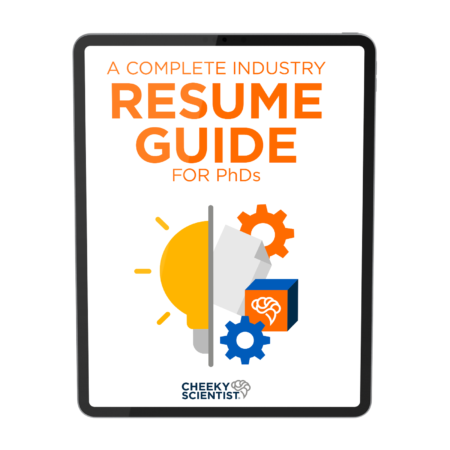
Industry Resume Guide for PhDs

Industry Resume Guide for PhDs

Cheeky Scientist

Learn how to craft the perfect industry resume to attract employers. In this eBook for PhDs, you will get access to proven resume templates, learn how to structure your bullet points, and discover which keywords industry employers want to see most on PhD resumes.

20 Skills To Put On Your Resume & LinkedIn Profile

20 Skills To Put On Your Resume & LinkedIn Profile

Cheeky Scientist

Learn the top 20 transferable skills that industry employers ranked as “most important” for PhDs to include on their resumes and LinkedIn profiles. In this eBook, you will learn to start speaking the language of industry so that hiring software algorithms and hiring managers will notice you.

Complete LinkedIn Guide For PhDs

Complete LinkedIn Guide For PhDs

Cheeky Scientist

Learn how to increase your LinkedIn visibility to employers by improving your SSI score and overall LinkedIn connections. In this ebook, you'll be given the tools you need to attract recruiters to you from LinkedIn Recruiter and drive employee referrals.